Dubai: The Ascendant Hub for Biotech Manufacturing, Distribution, and Commercialization in the Middle East
October 20, 2025

The Middle East’s ambitions in the life sciences sector are rapidly taking shape, and at the forefront of establishing a robust commercial ecosystem is Dubai. Leveraging its unparalleled connectivity, mature business infrastructure, and strategic vision, Dubai is fast becoming the preferred choice for biotech companies looking to manufacture, distribute, and commercialize their innovations across the vast MENA region and beyond. Its carefully cultivated free zones and pro-business environment offer a compelling proposition for enterprises seeking efficiency and scalability.
Building the Bio-Economy: Dubai’s Strategic Ecosystem for Manufacturing and Logistics
Dubai, and the wider UAE, is strategically positioning itself as a major biopharma and life sciences hub, a goal enshrined in initiatives like the Dubai Economic Agenda ‘D33’’. Dubai’s strength lies in its existing prowess as a global logistics and trade nexus, which it is now strategically redirecting to serve the sophisticated needs of the biopharma sector. At the heart of this transformation are two primary specialized zones: Dubai Science Park (DSP) and Jebel Ali Free Zone (JAFZA).
DSP, the dedicated life sciences ecosystem, has invested heavily in creating plug-and-play research and production capabilities. This includes the provision of Grade-A office space, LEED-certified laboratories, and warehousing amenities designed specifically for the temperature-sensitive logistics of medical products. Major global biopharmaceutical companies have established regional headquarters or operational centers in the park, leveraging this specialized infrastructure and the streamlined licensing for R&D and manufacturing activities.
Crucially, the government has anchored the biotech push to national economic strategies. The ‘Operation 300Bn’ national industrial strategy explicitly targets pharmaceuticals and medical devices as a key sector, aiming to significantly boost local manufacturing’s contribution to GDP. This has resulted in tangible incentives, such as simplified registration, fast-track approval processes for locally produced drugs, and the In-Country Value (ICV) program, which grants preferential weighting in government tenders to companies that localize production and procurement.
Furthermore, the connectivity of these zones is unmatched. The presence of JAFZA—one of the world’s largest ports—and the world-class air cargo facilities at Al Maktoum International Airport ensures an end-to-end cold chain logistics corridor, vital for time- and temperature-critical biotech distribution to the broader MENA, African, and Asian markets. For companies whose model centers on high-volume manufacturing, regional distribution, and efficient commercial sales, Dubai’s combined offering of infrastructure, tailored incentives, and mature governance makes it the functional nerve center of the Middle East’s life sciences supply chain.
Realizing the Bio-economy ambitions: Challenges and Opportunities
Dubai’s challenges can be categorized across the three core areas of its strategy: Manufacturing, Distribution/Commercialization, and the R&D/Talent Ecosystem.
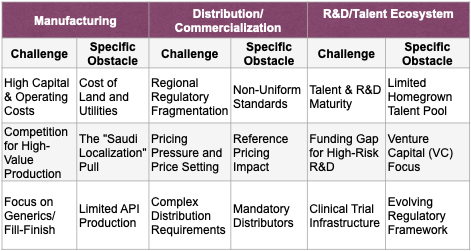
Dubai’s strategy, often in collaboration with the wider UAE Federal Government and Abu Dhabi, is to leverage its core strengths—logistics and business-friendliness—while strategically investing to plug the R&D and manufacturing gaps:
-
Building Specialized Ecosystems and Infrastructure: DSP is the cornerstone of Dubai’s life sciences strategy. It provides specialized, purpose-built infrastructure combined with free zone benefits. Dubai is leveraging its status as a global logistics hub (Jebel Ali Free Zone/JAFZA and Dubai Airport Free Zone/DAFZA). These zones are actively promoting GDP-certified warehousing and advanced cold chain management facilities to attract companies that need to securely store and distribute temperature-sensitive biologics across the MENA region. Dubai Industrial City: This zone is dedicating land and resources to attract large-scale manufacturing facilities, moving beyond logistics to hard production.
-
Attracting High-Value Technology and MNC Partnerships: The UAE is actively partnering with international Big Pharma and global Contract Development and Manufacturing Organizations (CDMOs). Incentivizing Localization: The government offers incentives to companies that commit to localizing production with the goal of medicine self-reliance. Dubai actively markets itself as the “Gateway to MENA, Africa, and South Asia,” positioning its distribution infrastructure as the most efficient and compliant route for global companies to access these markets.
-
Regulatory and R&D Enhancement: Emirates Drug Establishment (EDE): The establishment of the EDE at the federal level aims to consolidate and streamline drug regulation across the UAE, promoting uniformity and aligning the country’s standards with international best practices to facilitate clinical trials and product registration. Emirati Genome Programme: Designed to build a foundation for precision medicine and create a unique data asset that can attract global biopharma companies seeking diverse patient populations for research and drug development.
-
Talent Development: Strategies to attract and retain specialized researchers, as well as launching specialized educational and vocational programs in partnership with international academic institutions.
Summary
In conclusion, for biotech companies prioritizing efficient manufacturing, expansive distribution networks, and aggressive commercialization strategies in the Middle East, Dubai stands out as the optimal choice. Its established infrastructure, strategic location, and business-friendly policies create an unparalleled platform for innovation to reach patients and markets rapidly and effectively.
Disclaimer:
The information provided in this article is for general informational and educational purposes only. It is not intended as, and should not be construed as, professional business, legal, investment, or medical advice. Before making any strategic decisions, you should consult with a qualified professional. Calxera makes no representation or warranty of any kind, express or implied, regarding the accuracy, adequacy, validity, reliability, availability, or completeness of any information on this site.