A New Era of AI investment in Biopharma
September 16, 2025
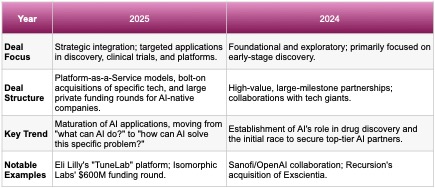
While AI investment is prevalent across almost every sector, the biopharma industry exhibits a distinct trajectory of increasing strategic collaboration. A key difference between 2024 and 2025 is a clear shift from exploratory partnerships to more strategic, integrated, and well-funded collaborations. These newer deals are focused on specific, high-impact applications of AI.
2024: Foundational Partnerships and Exploratory Deals
In 2024, the biopharma AI deal landscape was still in a more nascent, exploratory phase. While there were significant deals, they were often aimed at establishing a foothold in the AI space and testing the technology’s capabilities.
High-Value Partnerships:
Major deals in 2024 were characterized by large potential milestone payments, often exceeding $1 billion. Examples include Roche’s partnership with Dyno Therapeutics for AAV gene therapy vectors and Recursion’s acquisition of Exscientia, highlighting the industry’s willingness to invest heavily in the promise of AI.
AI for Drug Discovery:
The primary use case for AI collaborations was in the early stages of drug discovery, particularly in target identification and lead optimization. The Sanofi-OpenAI-Formation Bio collaboration was a landmark deal, showcasing a “first-in-class” approach to leveraging generative AI for drug development, although it was a foundational step rather than an immediate product launch.
Cross-Industry Collaborations:
There was a notable trend of biopharma companies partnering with technology giants and AI startups. This was exemplified by Alphabet’s Isomorphic Labs securing partnerships with both Lilly and Novartis. This period was about pairing the biopharma industry’s deep biological knowledge with the computational power of tech companies.
Investment in Infrastructure:
A key theme was the investment in the underlying AI infrastructure and platforms themselves. Deals like the launch of Xaira Therapeutics with over $1 billion in funding underscored a move to build end-to-end AI drug discovery capabilities from the ground up.
2025: Strategic Integration and Targeted Investments
In 2025, the biopharma industry’s approach to AI investment has matured. Companies are moving beyond proof-of-concept deals to establish long-term, foundational partnerships that fully integrate AI into their core operations. The focus is on leveraging AI for specific, critical functions, like accelerating drug discovery and optimizing clinical trials.
Platform-as-a-Service Models:
Large pharma companies are not just licensing individual AI models; they are acquiring access to entire AI-driven platforms. A notable example is Eli Lilly’s launch of “TuneLab,” which shares its internal AI/ML drug discovery models with selected biotech partners like Circle Pharma and insitro. This signals a shift toward building a collaborative ecosystem where a single platform can power multiple discovery efforts.
Focus on Specific Modalities:
Deals are increasingly centered on using AI to solve complex, targeted problems, such as protein structure prediction, molecular glue discovery, and RNA-based therapeutics. This is evident in collaborations like Absci’s partnership with Advanced Micro Devices (AMD) and TME Pharma’s work with aimed analytics to develop AI-based cancer drugs.
Significant Private Funding:
There’s been a trend of large, private funding rounds for AI-first biotechs. For instance, Isomorphic Labs (an Alphabet spin-out) secured a massive $600 million private round in Q1 2025, showing strong investor confidence in AI’s potential to transform drug discovery.
AI in Clinical Trials:
The application of AI is expanding beyond the lab and into the clinic. Companies are using AI to streamline patient recruitment, optimize trial design, and analyze real-world data, all with the goal of shortening development timelines and increasing the success rate of clinical programs.
Summary
In essence, 2024 was the year of building the foundation and making bold statements about AI’s importance. 2025 represents the year of executing on that vision, with more refined, integrated, and application-specific deals that aim to translate the promise of AI into tangible progress in the drug development pipeline.
Disclaimer:
The information provided in this article is for general informational and educational purposes only. It is not intended as, and should not be construed as, professional business, legal, investment, or medical advice. Before making any strategic decisions, you should consult with a qualified professional. Calxera makes no representation or warranty of any kind, express or implied, regarding the accuracy, adequacy, validity, reliability, availability, or completeness of any information on this site.