The $2.3 Billion Paradox: A Strategic White Paper for Executive Leadership and Venture Capitalists - III
February 12, 2026
Episode III:
Engineering Alpha—Slashing Risk and the Roadmap for Leaders
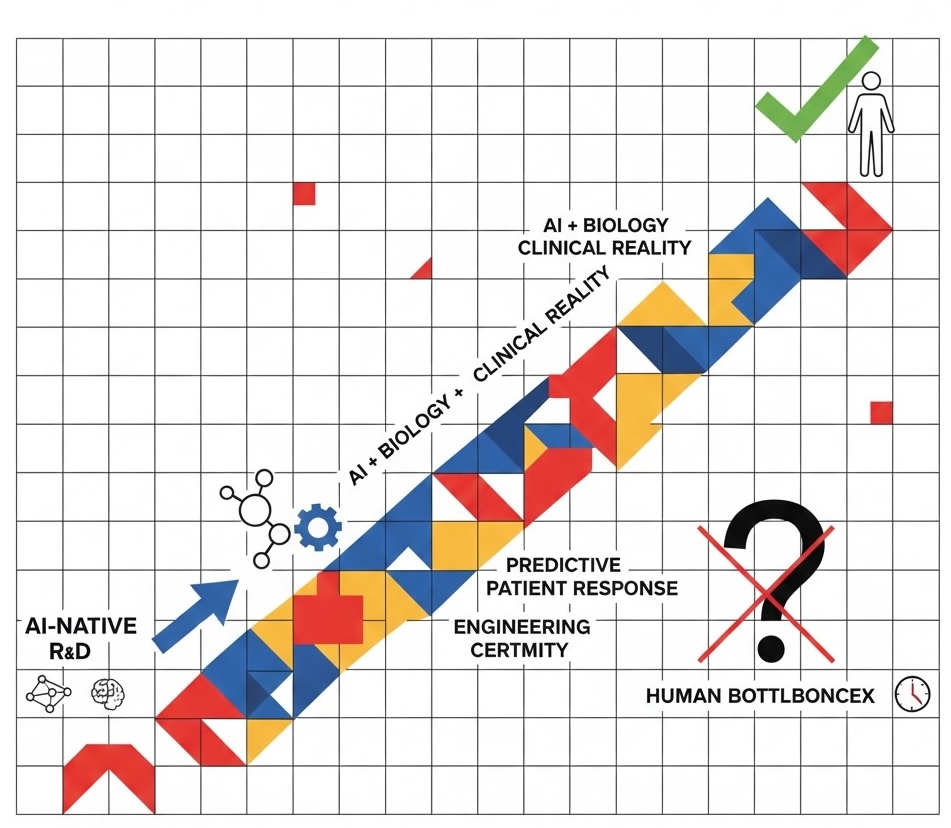
We’ve seen the $2.3 billion price tag (Ep. I) and the survivorship bias in the data (Ep. II). Now, the million-dollar question is: How do you actually win? The answer isn’t just “more AI”, or finding more drugs — It’s about Engineering Certainty. To wrap up our three-part series, we’re moving from the “Reality Check” of the data to the “Engineering Alpha”—the actual blueprint for companies to progress from “AI-enabled” to “AI-native”.
The Hype vs. The Calibrated Reality
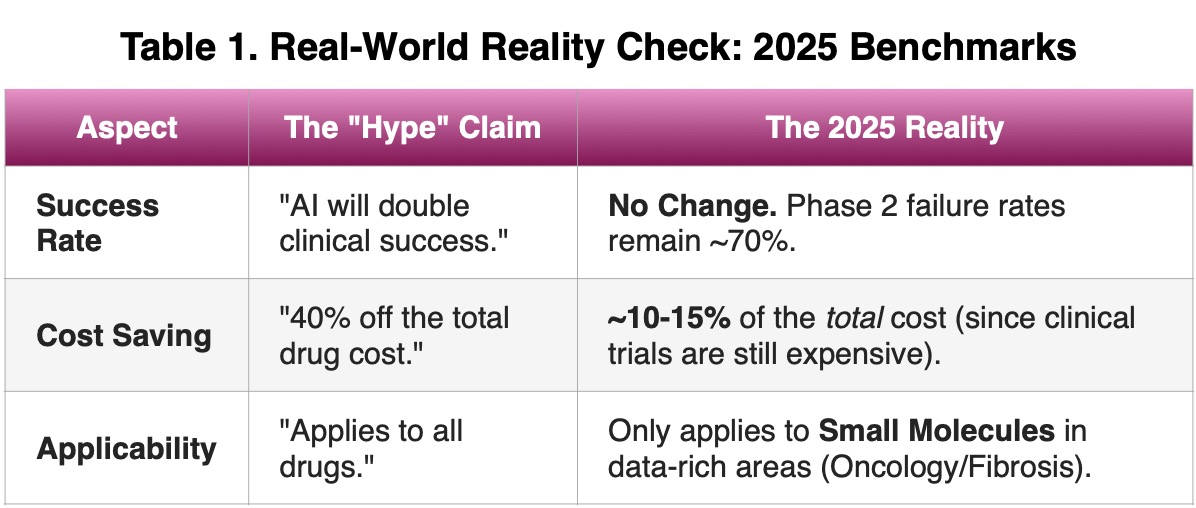
To separate signals from noise, we have to compare the claims and the reality. Table 1 illustrate the gap between what the industry claims and what the data proves. The good news is Acceleration is real — even if it is currently a niche phenomenon, not a universal law.
The “Failing Faster” Dividend vs. The AI-Implementation Tax
One of the few “universal” truths from 2025 is that AI’s greatest gift is helping companies “Fail Faster.” It allows companies to kill bad projects roughly 2 years earlier, preventing a $100M+ disaster at the Phase 3 stage. However, we must be realistic about the “AI-Implementation Tax.” Building high-quality, “clean” data pipelines and competing with Big Tech for elite architects has caused operational expenses (OpEx) to surge. If your AI doesn’t perfectly predict outcomes, these costs can quickly lead to a total loss. To better predict ROI of AI using success rate and efficiency, Table 2 provides a restructured comparison of the Optimistic Industry Estimates against the Risk-Adjusted/Calibrated reality of late 2025.
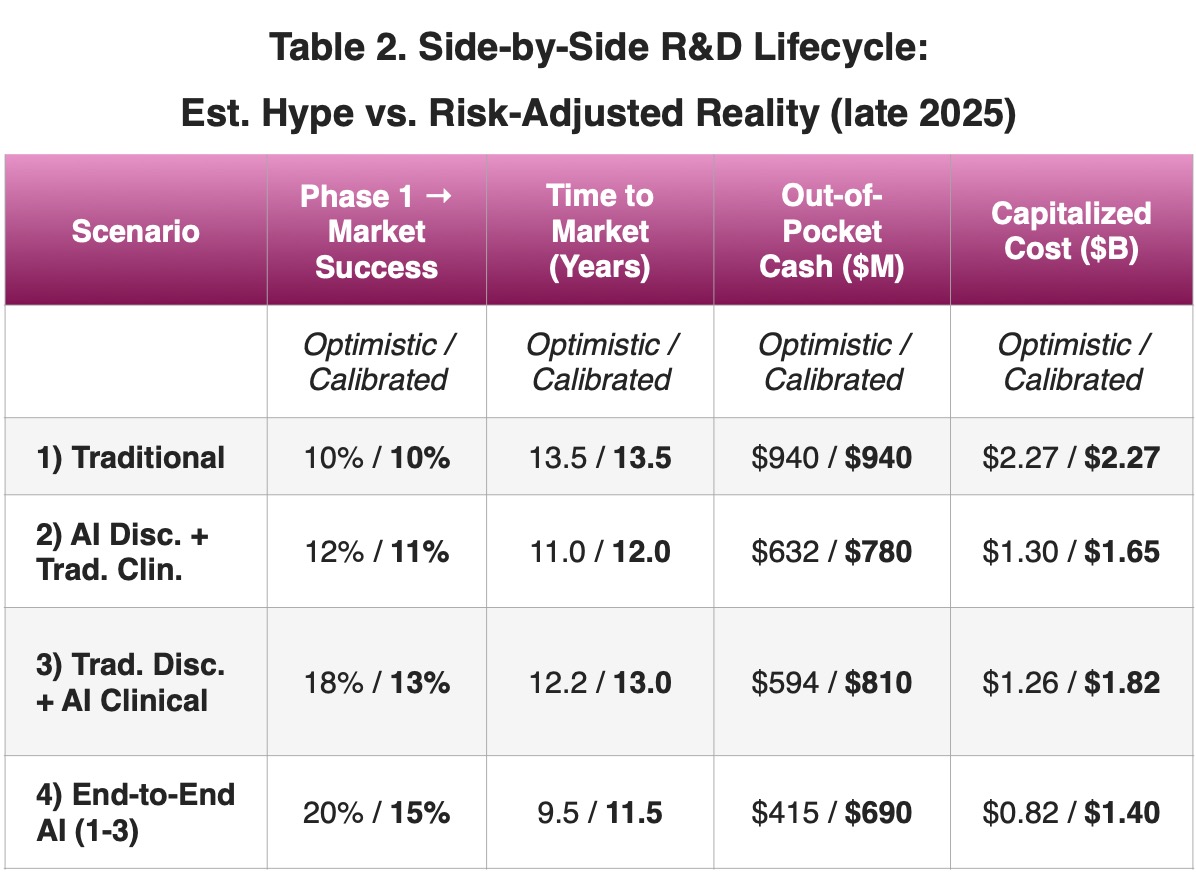
The differences between the Optimistic and Calibrated columns are driven by three factors discussed in this executive series:
1. The “Data Vacuum” & Integration Premium (Success & Cost)
In Scenario 3 and 4, the success rate is reduced because AI’s predictive power is currently bottlenecked by “dirty” clinical data.
2. The Implementation Tax (Time & Cash)
Time to market is slowed back down because the regulatory and legal start-up time for a clinical trial remains a human process.
3. Survivorship Bias Correction (Success Rate)
Scenario 4’s success rate is tempered because the 20% figure is largely based on Oncology and Small Molecules (data-rich). When you risk-adjust for other therapeutic areas where AI models are “guessing” based on much smaller datasets, the average success rate for an AI-enabled portfolio is only marginally higher than the traditional baseline.
Nevertheless, this is still a historic transformation. The Real Prize is “Time Value.” The “Alpha” in AI biopharma isn’t just finding a better molecule—it’s stopping the clock. For an investment bank or a global organization, the difference between a 13.5-year development cycle and a 11.5-year cycle is measured in billions of dollars of capitalized risk.
The Hidden Opportunity: The MedTech Gap
Here is the bold truth most boards are missing: we are applying 21st-century AI to 1990s-era clinical infrastructure.
The Bottleneck:
We can find a molecule in weeks, but we still rely on a heavily burdened “Site-Heavy” system which is facing increasing workforce crisis.
The Overlooked Alpha:
While “AI-Biotech” is saturated, AI-integrated MedTech is drastically underfunded and overlooked.
The next frontier for cost reduction isn’t a better algorithm—it’s connected infrastructure. Software cannot fix a Hardware problem; While Biopharma’s AI reduces the need for trials by making better drugs, MedTech’s AI reduces the friction of trials. To fundamentally transform the R&D lifecycle, we must move from “Digital Silos” to a “Physical Overhaul.”
Our Suggestions for Savvy Business Leaders
Based on the evidence, we suggest three “No-Nonsense” strategic pivots:
1. Demand “Proof of Biology,” Not Just “Proof of Code”:
Stop being impressed by computational power. Ask for the “Wet Lab” validation. If the AI isn’t in a constant feedback loop with physical biology, it’s just a spreadsheet.
2. Pivot from “Discovery” to “Development”:
The industry is crowded with companies finding molecules. But the “last mile” of drug development—the clinical phase—is where 80% of the capital is lost. The “Alpha” is shifting investment focus to the overlooked Alpha—the infrastructure that is sustainable and more efficient.
3. Defund the Middlemen:
Most R&D costs are eaten by “Site Inflation.” Savvy leaders should invest in “Site-Free” ecosystems—using edge devices and real-time monitoring to bypass traditional, inefficient clinical sites.
The Closing
The AI revolution is real, but it is still a niche phenomenon. The winners of 2026 won’t be those with the best algorithms, but those who successfully bridge the gap between digital “Hype” and physical “MedTech” reality. Although investment of AI in healthcare is rapidly growing, Biopharma AI vs. MedTech AI is experiencing disproportional capital allocation with the former commanding much higher capital share. MedTech/Device may be an unexploited gold mine for investors seeking immediate strategic value. As the landscape continues to evolve, so will our coverage - Stay tuned as we expand on these topics in our upcoming features.
Let’s build an R&D engine that survives the data, not just the hype.
Disclaimer:
The information provided in this article is for general informational and educational purposes only. It is not intended as, and should not be construed as, professional business, legal, investment, or medical advice. Before making any strategic decisions, you should consult with a qualified professional. Calxera makes no representation or warranty of any kind, express or implied, regarding the accuracy, adequacy, validity, reliability, availability, or completeness of any information on this site.